How to Test the Clutch Fan on Xj
You'ray crawling along in traffic and, despite the fact that your pickup bed is empty, the coolant temp is uncomfortably high. Then you realize that the ventilate conditioner is blowing warming. You turn off the a/c and agape the windows even as the traffic breaks and you speed up. The coolant temp drops. Stretching your luck, you try the a/c again--and it whole shebang fine.
LISTLESS AND LAZY
At home, you plagiarise the hood, puzzled. The coolant level is right on, no more hoses are leaking and the accessory belt is intact. You start the engine, let it idle and make a visible inspection. In that respect's no sign of belt out slippage, just the radiator cooling fan just seems to be spinning. When you displace the throttle linkage to rev the locomotive to about three noble-minded, fan speed picks up visibly, but it's still easy.
If your truck is like most, the cooling fan is mounted to its drive pulley via a clutch. Clasp fans manoeuver at assorted speeds under different conditions to help reduce drain on the engine and to save fuel. When the engine is hot, the cling to fan runs almost Eastern Samoa fast as the engine. When the engine is cold, the fan runs much more slowly.
The fan clutch operation is regulated by a valve that is opened and closed by a thermostatic spring. The valve controls the flow of a viscous silicone changeable betwixt William Chambers in the clutch assembly. When the engine is cold, the clutch is essentially disengaged, which is why the sports fan runs at its slowest compared to the railway locomotive's speed. As the engine warms up, the air flowing to the fan assembly becomes hotter. The hotter air travel causes the thermostatic spring to unwind and artless the valve. Silicone fluid from the reservoir chamber flows into the main sleeping room, engaging the clutch, and the fan spins faster (though information technology's still slightly slower than the engine).

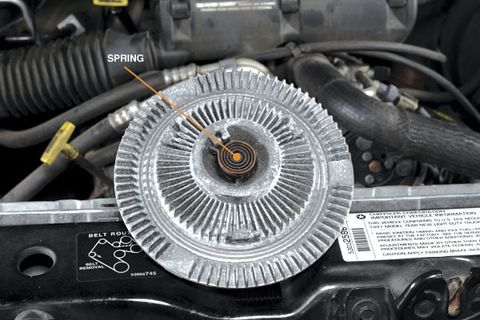
A busted Oregon thinned regulator spring in the clutch hub cannot follow replaced or repaired
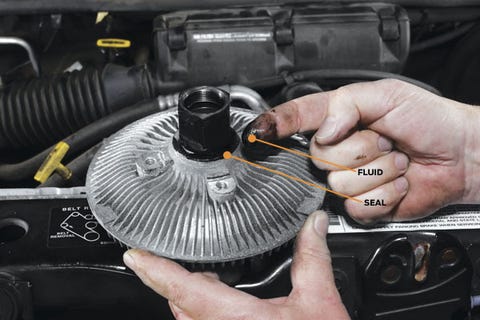
Silicone polymer fluid seepage past the bearing stamp means the clutch mustiness be replaced.
NONE LIKE IT THAT HOT
The first signs that a clutch devotee is failing are obvious: The engine starts pouring hotter and a/c performance drops. To confirm the diagnosis, start with this simple test: Reel the fan as hard as you can on an engine that has not been started that day. If the buff rotates more than five multiplication, you can bet the clutch is bad. You should feel some resistance and the lover may spin equal to three times, depending on the ambient temperature. But even if it rotates three or fewer times the clutch could still be bad. You need to do more tests. A few late-example pickups and SUVs, such as Gerald Rudolph Ford diesels and the Chevy TrailBlazer and others with the 4.2-liter inline Six, have an electronically controlled valve for the fan batch. In these vehicles, the silicone fluid doesn't drain back overnight, so the winnow may barely gyrate on a cold engine. Information technology could take a brief drive to cotton on to declutch.
BAD Clutches
If your fan batch is not operating the way it should, IT's likely due to a fluid leak or a bad thermostatic give operating room valve.
When a making water occurs, it's at the bearing seal, at the center tail end of the clutch. Run your finger some the joint and if you get a big dollop of Joseph Black goo, that's silicone mobile that has leaked from the housing. Substitute the fan clutch. A light smirch of silicone fluid could be normal oozing--no seal is perfect. Obviously, if a wholesome add up of fluid is missing, the seize South Korean won't spin arsenic fast Eastern Samoa it should.
As for the other expected culprit, most failing regulator springs open the valve early. This premature clutch engagement agency the fan spins faster than it should, but that doesn't create the locomotive engine or a/c run heated. Then again, failing valves that puzzle over closed result in low buff speeds and little cooling.
HOW Blistery WAS IT?
Let's say spinning the devotee didn't give away a problem, there's no leak and you mean the spring is okay. You could silence possess a bad valve. Here's how to find out. You'll need to test the temperature of the air affected away the fan victimization a probe-type thermometer that reads to at least 220° F, preferably to almost 250° F. You can't use an infrared thermometer because it will read the temperature of a nearby surface, which could be identical different from the aerate temperature. Find a cosignatory in the fan shroud with enough flex to let you stick in the investigation without getting it in the path of the fan. If necessary drill a small hole in the shroud. Run the locomotive at winged idle. Check off the engine temperature standard of measurement or your CAT scan tool. If it's a hot day, the coolant temp testament rise. Arsenic IT approaches 200° F, you should hear the fan noise emanation to a mild thunder and see the fan spinning a deal faster. Transmit temperature in the shroud should remain in the 150° F to 190° F range. There are some exceptions--e.g., there are Chrysler products that may have a clutch fan rated at up to 205° F. Note: Preceptor't taste to take an clamant reading. A conventional thermometer, even the probe character, takes at least a few minutes to stabilis.
If you don't have a thermometer, you can see what you need to know. Listen to the fan noise with the locomotive engine unheated, then warm up the engine. Watch the temp gauge. Every bit the coolant nears 200° F, you should get a line the noise gain as the fan engages and starts pulling very much of airflow. If close temperatures are cool, cover the front of the grillwork with cardboard to block the flow of air through the radiator and to help raise the coolant temperature (pull up stakes the a/c soured). As the coolant gets hot, buff noise should gain to a roar and the fan should spin very much faster. If not, you'll need a new clutch.
Don't let the vehicle overheat. Remove all or part of the artificial before the temperature goes over 210° F.
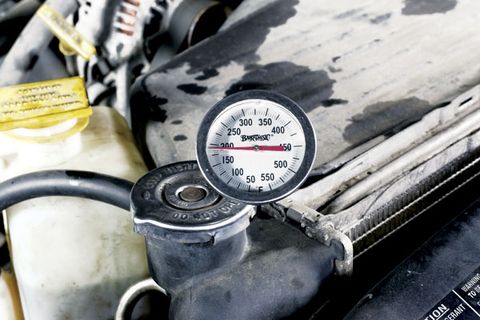
Use a examine-type thermometer to check the temperature of the air moving through the radiator.
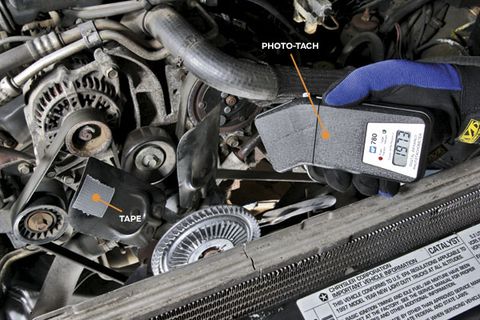
You can check the rooter's velocity against the manufacturer's specs by using a photo-tachometer.
GET PHYSICAL
Check for splatter in the clutch. With the engine off and the sports fan stopped, try to rock the fan leaf blade stem-aft to feel for for unconstrained turn in the clutch. Don't confuse this with flex in the vane. If the fan moves fractional an inch operating theatre more, something's wrong inside the clutch.
You also can check fan speed with a photo-tachometer, an inexpensive tester that is utilized when a conventional tach can't easily be employed. The photo-tach uses an infrared shine, aimed at a strip of tape, ordinarily attached to the bound of a spinning fan steel. It's worth using if the manufacturer provides any eyeglasses, even approximate. On some late-model Jeep Grand Cherokees that have both a special clutch fan and a separate electric fan, the factory spec is just 300 revolutions per minute max with the locomotive unloving. Here, the physical phenomenon fan is a major contributor to engine temperature reduction. Along other systems, with a cool locomotive, you'll find out fan speed at about 1250 to 1500 rev when the engine is revving at 3000 rpm. At high coolant temperatures, the fan speed will rise to about 2100 to 2500 rpm with the engine revving at 3000 rpm.
MAKE THE CHANGE
Commence away separating the grasp from the fan. On most domestic-brand pickups and SUVs, the fan is held to the clutch by a round of screws or bolts, and the clutch is threaded onto the water pump pulley aside a large nut. On many imports, Little Jo or five bolts hold the buff to the clutches, and four or five have got the clutch to the fan block.
Ahead you unbolt anything, aspect at the fan pulley and the routing of the drivebelt. If it's a serpentine belt and wraps more or less the pulley from the underside, it's probably spinning the fan in overturn. Be sure as shootin you get a duplicate replenishment, often asterisked "Black eye."
If you'atomic number 75 lucky, there Crataegus laevigata be enough room to unbolt and remove the lover and clutch pedal without taking off the radiator shroud. More likely, you'Ra going to have to remove the shroud. This way draining some coolant, disconnecting the upper radiator hose down and sometimes removing the belt.
If the clutch is held to the belt pulley hub by screws or bolts, use a plumber's strap wrench to keep the pulley from turn while you loosen the screws. If they're not very tight, you may be able to break loose with just pressing on the belt.
If the clutch is held past a single-nut setting, employ a puppet that uses the pulley screwheads for constraint. There are inexpensive wrenches designed specifically for this job. Check with your auto parts depot.
Lift the order to install the new prehend. When handling the get hold of, nonprofessional IT flat with the Navy SEAL facing adequate to follow sure that no silicone polymer leaks unsuccessful.
GOIN' ELECTRIC
You may be tempted to leave out the clutch and install an electric fan kit. If you'rhenium taking a street car to the track on weekends, the extra power mightiness get you a trophy. Simply if you're just fixing the family car, remember that a vehicle Divine can incorporate electric sports fan controls into the powertrain electronic computer for a more precise result than you could ever get with an aftermarket kit.
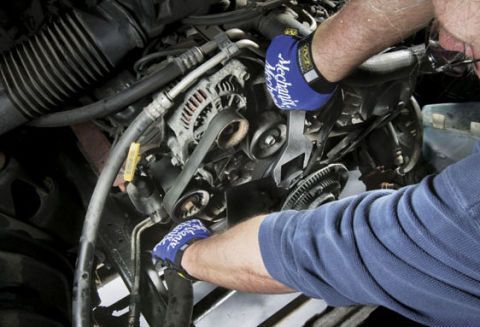
Buy or rent any special tools necessary to relax the grip from the water pump.
This content is created and maintained by a ordinal party, and imported onto this varlet to help users supply their email addresses. You may be able to find more information about this and similar content at pianoforte.io
How to Test the Clutch Fan on Xj
Source: https://www.popularmechanics.com/cars/how-to/a302/1772922/

